3d drawing of person in hole
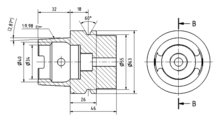
An engineering cartoon is a type of technical cartoon that is used to convey information nearly an object. A common use is to specify the geometry necessary for the structure of a component and is chosen a particular drawing. Ordinarily, a number of drawings are necessary to completely specify even a simple component. The drawings are linked together by a master drawing or assembly drawing which gives the cartoon numbers of the subsequent detailed components, quantities required, structure materials and possibly 3D images that can be used to locate private items. Although mostly consisting of pictographic representations, abbreviations and symbols are used for brevity and additional textual explanations may also be provided to convey the necessary data.
The process of producing engineering drawings is often referred to equally technical drawing or drafting (draughting).[1] Drawings typically comprise multiple views of a component, although boosted scratch views may be added of details for further explanation. Just the data that is a requirement is typically specified. Key data such as dimensions is unremarkably only specified in one identify on a drawing, avoiding redundancy and the possibility of inconsistency. Suitable tolerances are given for disquisitional dimensions to let the component to be manufactured and function. More than detailed production drawings may exist produced based on the information given in an engineering drawing. Drawings have an information box or title block containing who drew the drawing, who approved it, units of dimensions, meaning of views, the title of the drawing and the cartoon number.
History [edit]
Technical cartoon has existed since ancient times. Complex technical drawings were made in renaissance times, such every bit the drawings of Leonardo da Vinci. Modernistic engineering drawing, with its precise conventions of orthographic projection and scale, arose in France at a time when the Industrial Revolution was in its infancy. Fifty. T. C. Rolt's biography of Isambard Kingdom Brunel[ii] says of his father, Marc Isambard Brunel, that "It seems fairly certain that Marc's drawings of his cake-making machinery (in 1799) fabricated a contribution to British engineering technique much greater than the machines they represented. For information technology is safe to assume that he had mastered the art of presenting three-dimensional objects in a two-dimensional aeroplane which nosotros at present call mechanical drawing. Information technology had been evolved by Gaspard Monge of Mezieres in 1765 just had remained a military secret until 1794 and was therefore unknown in England."[ii]
Standardization and disambiguation [edit]
Engineering science drawings specify requirements of a component or assembly which can be complicated. Standards provide rules for their specification and interpretation. Standardization also aids internationalization, considering people from different countries who speak dissimilar languages can read the same engineering drawing, and interpret information technology the aforementioned mode.
I major ready of engineering drawing standards is ASME Y14.5 and Y14.5M (most recently revised in 2009). These apply widely in the United states of america, although ISO 8015 (Geometrical product specifications (GPS) — Fundamentals — Concepts, principles and rules) is now also important.
In 2011, a new revision of ISO 8015 (Geometrical product specifications (GPS) — Fundamentals — Concepts, principles and rules) was published containing the Invocation Principle. This states that, "One time a portion of the ISO geometric production specification (GPS) system is invoked in a mechanical engineering science product documentation, the entire ISO GPS system is invoked." It also goes on to state that marking a drawing "Tolerancing ISO 8015" is optional. The implication of this is that any drawing using ISO symbols can simply be interpreted to ISO GPS rules. The only way not to invoke the ISO GPS system is to invoke a national or other standard. Britain, BS 8888 (Technical Production Specification) has undergone important updates in the 2010s.
Media [edit]
For centuries, until the 1970s, all engineering cartoon was done manually by using pencil and pen on paper or other substrate (e.chiliad., vellum, mylar). Since the advent of computer-aided pattern (CAD), engineering science drawing has been done more and more in the electronic medium with each passing decade. Today most applied science drawing is washed with CAD, merely pencil and paper take not entirely disappeared.
Some of the tools of manual drafting include pencils, pens and their ink, straightedges, T-squares, French curves, triangles, rulers, protractors, dividers, compasses, scales, erasers, and tacks or push pins. (Slide rules used to number among the supplies, too, just nowadays even manual drafting, when information technology occurs, benefits from a pocket calculator or its onscreen equivalent.) And of course the tools also include drawing boards (drafting boards) or tables. The English idiom "to go dorsum to the cartoon board", which is a figurative phrase meaning to rethink something altogether, was inspired by the literal act of discovering pattern errors during production and returning to a cartoon lath to revise the technology drawing. Drafting machines are devices that help manual drafting by combining drawing boards, straightedges, pantographs, and other tools into i integrated drawing environment. CAD provides their virtual equivalents.
Producing drawings usually involves creating an original that is and so reproduced, generating multiple copies to be distributed to the shop floor, vendors, visitor archives, and so on. The classic reproduction methods involved blueish and white appearances (whether white-on-blue or blue-on-white), which is why engineering drawings were long chosen, and fifty-fifty today are still ofttimes chosen, "blueprints" or "bluelines", even though those terms are anachronistic from a literal perspective, since most copies of engineering science drawings today are made past more modern methods (often inkjet or laser printing) that yield blackness or multicolour lines on white paper. The more than generic term "print" is now in common usage in the U.S. to mean whatsoever newspaper re-create of an engineering drawing. In the case of CAD drawings, the original is the CAD file, and the printouts of that file are the "prints".
Systems of dimensioning and tolerancing [edit]
Almost all engineering drawings (except perhaps reference-simply views or initial sketches) communicate not but geometry (shape and location) only also dimensions and tolerances[ane] for those characteristics. Several systems of dimensioning and tolerancing take evolved. The simplest dimensioning system just specifies distances between points (such as an object'south length or width, or pigsty heart locations). Since the advent of well-developed interchangeable manufacture, these distances have been accompanied by tolerances of the plus-or-minus or min-and-max-limit types. Coordinate dimensioning involves defining all points, lines, planes, and profiles in terms of Cartesian coordinates, with a common origin. Coordinate dimensioning was the sole best choice until the mail-World War Two era saw the development of geometric dimensioning and tolerancing (GD&T), which departs from the limitations of coordinate dimensioning (e.yard., rectangular-just tolerance zones, tolerance stacking) to allow the well-nigh logical tolerancing of both geometry and dimensions (that is, both grade [shapes/locations] and sizes).
Common features [edit]
Drawings convey the post-obit critical information:
- Geometry – the shape of the object; represented as views; how the object will look when it is viewed from various angles, such every bit front, superlative, side, etc.
- Dimensions – the size of the object is captured in accepted units.
- Tolerances – the allowable variations for each dimension.
- Material – represents what the particular is made of.
- End – specifies the surface quality of the item, functional or corrective. For example, a mass-marketed product usually requires a much college surface quality than, say, a component that goes inside industrial mechanism.
Line styles and types [edit]

Standard engineering drawing line types
A diversity of line styles graphically represent concrete objects. Types of lines include the following:
- visible – are continuous lines used to depict edges directly visible from a particular angle.
- hidden – are brusque-dashed lines that may be used to correspond edges that are non directly visible.
- eye – are alternately long- and short-dashed lines that may be used to represent the axes of circular features.
- cutting plane – are thin, medium-dashed lines, or thick alternately long- and double short-dashed that may be used to define sections for section views.
- section – are thin lines in a design (design determined past the textile beingness "cut" or "sectioned") used to indicate surfaces in section views resulting from "cut". Department lines are commonly referred to as "cross-hatching".
- phantom – (not shown) are alternately long- and double brusk-dashed thin lines used to represent a feature or component that is not office of the specified part or assembly. E.g. billet ends that may be used for testing, or the machined product that is the focus of a tooling drawing.
Lines can also be classified by a letter of the alphabet classification in which each line is given a letter of the alphabet.
- Type A lines show the outline of the feature of an object. They are the thickest lines on a drawing and washed with a pencil softer than HB.
- Blazon B lines are dimension lines and are used for dimensioning, projecting, extending, or leaders. A harder pencil should be used, such as a 2H pencil.
- Blazon C lines are used for breaks when the whole object is not shown. These are freehand drawn and only for short breaks. 2H pencil
- Blazon D lines are similar to Type C, except these are zigzagged and only for longer breaks. 2H pencil
- Type E lines indicate subconscious outlines of internal features of an object. These are dotted lines. 2H pencil
- Blazon F lines are Type E lines, except these are used for drawings in electrotechnology. 2H pencil
- Type G lines are used for centre lines. These are dotted lines, simply a long line of 10–20 mm, and so a 1 mm gap, then a small-scale line of 2 mm. 2H pencil
- Type H lines are the same as blazon K, except that every second long line is thicker. These indicate the cutting aeroplane of an object. 2H pencil
- Type K lines indicate the alternate positions of an object and the line taken by that object. These are drawn with a long line of 10–twenty mm, so a small gap, then a small line of ii mm, then a gap, and then another small line. 2H pencil.
Multiple views and projections [edit]
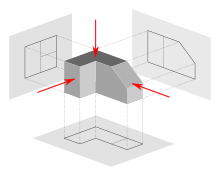
Epitome of a part represented in start-bending projection

Symbols used to define whether a projection is either offset-angle (left) or third-angle (right).

Several types of graphical projection compared
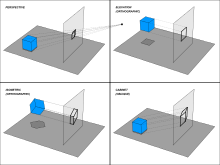
Various projections and how they are produced
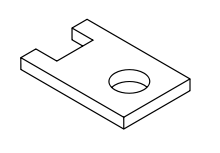
Isometric view of the object shown in the engineering drawing below.
In most cases, a unmarried view is non sufficient to show all necessary features, and several views are used. Types of views include the following:
Multiview projection [edit]
A multiview project is a type of orthographic projection that shows the object equally it looks from the front end, right, left, top, bottom, or back (e.g. the main views), and is typically positioned relative to each other according to the rules of either commencement-angle or tertiary-angle project. The origin and vector direction of the projectors (too chosen projection lines) differs, as explained below.
- In first-bending project, the parallel projectors originate every bit if radiated from backside the viewer and laissez passer through the 3D object to project a 2D image onto the orthogonal plane behind it. The 3D object is projected into 2D "newspaper" space as if you lot were looking at a radiograph of the object: the pinnacle view is under the front view, the right view is at the left of the front view. First-angle projection is the ISO standard and is primarily used in Europe.
- In third-angle projection, the parallel projectors originate equally if radiated from the far side of the object and pass through the 3D object to projection a 2D paradigm onto the orthogonal plane in front of information technology. The views of the 3D object are similar the panels of a box that envelopes the object, and the panels pin as they open upwards apartment into the plane of the drawing.[3] Thus the left view is placed on the left and the top view on the top; and the features closest to the forepart of the 3D object will appear closest to the forepart view in the drawing. Third-angle projection is primarily used in the United States and Canada, where it is the default project arrangement co-ordinate to ASME standard ASME Y14.3M.
Until the belatedly 19th century, first-bending projection was the norm in N America as well every bit Europe;[4] [5] only circa the 1890s, third-bending projection spread throughout the N American engineering and manufacturing communities to the point of becoming a widely followed convention,[iv] [5] and information technology was an ASA standard past the 1950s.[5] Circa World War I, British do was often mixing the use of both projection methods.[4]
Every bit shown above, the determination of what surface constitutes the front, back, top, and lesser varies depending on the project method used.
Non all views are necessarily used.[vi] Generally merely as many views are used equally are necessary to convey all needed data conspicuously and economically.[7] The forepart, top, and right-side views are ordinarily considered the core grouping of views included by default,[8] only any combination of views may be used depending on the needs of the particular blueprint. In improver to the six primary views (front, dorsum, meridian, bottom, right side, left side), whatever auxiliary views or sections may be included every bit serve the purposes of part definition and its advice. View lines or section lines (lines with arrows marked "A-A", "B-B", etc.) ascertain the direction and location of viewing or sectioning. Sometimes a note tells the reader in which zone(s) of the drawing to discover the view or section.
Auxiliary views [edit]
An auxiliary view is an orthographic view that is projected into whatsoever plane other than one of the half dozen primary views.[9] These views are typically used when an object contains some sort of inclined airplane. Using the auxiliary view allows for that inclined plane (and any other meaning features) to be projected in their truthful size and shape. The truthful size and shape of whatsoever feature in an engineering cartoon can only be known when the Line of Sight (LOS) is perpendicular to the airplane beingness referenced. It is shown like a 3-dimensional object. Auxiliary views tend to brand use of axonometric projection. When existing all by themselves, auxiliary views are sometimes known as pictorials.
Isometric projection [edit]
An isometric project shows the object from angles in which the scales along each axis of the object are equal. Isometric projection corresponds to rotation of the object by ± 45° about the vertical axis, followed past rotation of approximately ± 35.264° [= arcsin(tan(30°))] about the horizontal axis starting from an orthographic project view. "Isometric" comes from the Greek for "same measure". One of the things that makes isometric drawings then bonny is the ease with which 60° angles can be synthetic with merely a compass and straightedge.
Isometric projection is a blazon of axonometric projection. The other two types of axonometric projection are:
- Dimetric project
- Trimetric projection
Oblique projection [edit]
An oblique project is a uncomplicated type of graphical project used for producing pictorial, 2-dimensional images of three-dimensional objects:
- information technology projects an prototype by intersecting parallel rays (projectors)
- from the iii-dimensional source object with the cartoon surface (projection plan).
In both oblique projection and orthographic projection, parallel lines of the source object produce parallel lines in the projected image.
Perspective project [edit]
Perspective is an approximate representation on a apartment surface, of an image as it is perceived by the heart. The 2 most feature features of perspective are that objects are fatigued:
- Smaller as their distance from the observer increases
- Foreshortened: the size of an object's dimensions forth the line of sight are relatively shorter than dimensions across the line of sight.
Department Views [edit]
Projected views (either Auxiliary or Multiview) which evidence a cross department of the source object along the specified cutting plane. These views are ordinarily used to bear witness internal features with more clarity than may be bachelor using regular projections or hidden lines. In assembly drawings, hardware components (e.g. nuts, screws, washers) are typically not sectioned. Department view is a half side view of object.
Calibration [edit]
Plans are normally "scale drawings", meaning that the plans are fatigued at specific ratio relative to the actual size of the identify or object. Various scales may be used for different drawings in a fix. For example, a flooring plan may exist drawn at 1:50 (1:48 or 1⁄iv ″ = ane′ 0″) whereas a detailed view may be drawn at 1:25 (1:24 or 1⁄2 ″ = i′ 0″). Site plans are ofttimes drawn at ane:200 or i:100.
Scale is a nuanced subject field in the use of engineering drawings. On one hand, it is a general principle of technology drawings that they are projected using standardized, mathematically certain project methods and rules. Thus, great effort is put into having an engineering cartoon accurately draw size, shape, course, aspect ratios between features, and so on. And yet, on the other hand, in that location is some other general principle of applied science cartoon that nigh diametrically opposes all this effort and intent—that is, the principle that users are not to calibration the cartoon to infer a dimension non labeled. This stern admonition is often repeated on drawings, via a average note in the title block telling the user, "Practise NOT Calibration DRAWING."
The explanation for why these two nearly opposite principles can coexist is as follows. The first principle—that drawings will be made then carefully and accurately—serves the prime goal of why engineering cartoon even exists, which is successfully communicating part definition and acceptance criteria—including "what the part should look like if you lot've made it correctly." The service of this goal is what creates a drawing that one even could scale and get an authentic dimension thereby. And thus the cracking temptation to do so, when a dimension is wanted simply was not labeled. The second principle—that even though scaling the drawing will usually work, one should even so never practice it—serves several goals, such as enforcing total clarity regarding who has authorization to discern blueprint intent, and preventing erroneous scaling of a drawing that was never drawn to scale to begin with (which is typically labeled "drawing non to scale" or "scale: NTS"). When a user is forbidden from scaling the drawing, s/he must turn instead to the engineer (for the answers that the scaling would seek), and s/he will never erroneously scale something that is inherently unable to be accurately scaled.
But in some ways, the advent of the CAD and MBD era challenges these assumptions that were formed many decades ago. When part definition is defined mathematically via a solid model, the assertion that one cannot interrogate the model—the direct analog of "scaling the cartoon"—becomes ridiculous; because when part definition is defined this way, information technology is not possible for a drawing or model to exist "not to scale". A 2D pencil drawing tin can exist inaccurately foreshortened and skewed (and thus not to scale), still still exist a completely valid function definition as long equally the labeled dimensions are the only dimensions used, and no scaling of the drawing by the user occurs. This is considering what the cartoon and labels convey is in reality a symbol of what is wanted, rather than a true replica of it. (For instance, a sketch of a pigsty that is clearly not round nonetheless accurately defines the part every bit having a true round hole, equally long as the label says "10mm DIA", considering the "DIA" implicitly but considerately tells the user that the skewed drawn circle is a symbol representing a perfect circle.) But if a mathematical model—essentially, a vector graphic—is declared to be the official definition of the part, so any amount of "scaling the drawing" can make sense; there may still be an error in the model, in the sense that what was intended is not depicted (modeled); but there can be no fault of the "non to calibration" type—because the mathematical vectors and curves are replicas, not symbols, of the part features.
Even in dealing with 2D drawings, the manufacturing earth has inverse since the days when people paid attention to the scale ratio claimed on the print, or counted on its accurateness. In the past, prints were plotted on a plotter to exact scale ratios, and the user could know that a line on the drawing 15mm long corresponded to a 30mm part dimension because the cartoon said "1:2" in the "scale" box of the title block. Today, in the era of ubiquitous desktop printing, where original drawings or scaled prints are often scanned on a scanner and saved as a PDF file, which is so printed at any percentage magnification that the user deems handy (such as "fit to paper size"), users have pretty much given up caring what scale ratio is claimed in the "scale" box of the title block. Which, nether the rule of "practise not scale drawing", never really did that much for them anyway.
Showing dimensions [edit]
Sizes of drawings [edit]


Sizes of drawings typically comply with either of two dissimilar standards, ISO (Globe Standard) or ANSI/ASME Y14.1 (American).
The metric drawing sizes represent to international paper sizes. These developed further refinements in the second one-half of the twentieth century, when photocopying became cheap. Engineering drawings could be readily doubled (or halved) in size and put on the adjacent larger (or, respectively, smaller) size of paper with no waste of space. And the metric technical pens were called in sizes so that one could add particular or drafting changes with a pen width changing past approximately a cistron of the square root of 2. A full set of pens would take the post-obit nib sizes: 0.13, 0.xviii, 0.25, 0.35, 0.5, 0.7, 1.0, ane.5, and 2.0 mm. However, the International Organization for Standardization (ISO) called for four pen widths and set a color lawmaking for each: 0.25 (white), 0.35 (yellow), 0.5 (brown), 0.7 (bluish); these nibs produced lines that related to diverse text character heights and the ISO paper sizes.
All ISO paper sizes have the aforementioned aspect ratio, 1 to the square root of 2, pregnant that a document designed for whatsoever given size tin can be enlarged or reduced to any other size and will fit perfectly. Given this ease of changing sizes, it is of class mutual to copy or impress a given document on different sizes of paper, especially within a series, eastward.chiliad. a drawing on A3 may be enlarged to A2 or reduced to A4.
The U.S. customary "A-size" corresponds to "letter" size, and "B-size" corresponds to "ledger" or "tabloid" size. There were also once British paper sizes, which went past names rather than alphanumeric designations.
American Society of Mechanical Engineers (ASME) ANSI/ASME Y14.1, Y14.2, Y14.iii, and Y14.5 are commonly referenced standards in the U.S.
Technical lettering [edit]
Technical lettering is the process of forming letters, numerals, and other characters in technical drawing. Information technology is used to describe, or provide detailed specifications for an object. With the goals of legibility and uniformity, styles are standardized and lettering ability has little relationship to normal writing ability. Engineering science drawings use a Gothic sans-serif script, formed by a serial of short strokes. Lower case letters are rare in most drawings of machines. ISO Lettering templates, designed for use with technical pens and pencils, and to accommodate ISO paper sizes, produce lettering characters to an international standard. The stroke thickness is related to the character height (for example, two.5mm high characters would have a stroke thickness - pen pecker size - of 0.25mm, 3.5 would use a 0.35mm pen and then forth). The ISO character set (font) has a seriffed one, a barred seven, an open four, six, and nine, and a round topped iii, that improves legibility when, for example, an A0 drawing has been reduced to A1 or even A3 (and peradventure enlarged back or reproduced/faxed/ microfilmed &c). When CAD drawings became more pop, especially using US American software, such every bit AutoCAD, the nearest font to this ISO standard font was Romantic Simplex (RomanS) - a proprietary shx font) with a manually adjusted width factor (over ride) to make it look as near to the ISO lettering for the drawing lath. However, with the closed 4, and arced vi and ix, romans.shx typeface could be difficult to read in reductions. In more contempo revisions of software packages, the TrueType font ISOCPEUR reliably reproduces the original drawing board lettering stencil manner, yet, many drawings accept switched to the ubiquitous Arial.ttf.
Conventional parts (areas) [edit]
Title block [edit]
Every engineering cartoon must have a championship cake.[10] [xi] [12]
The title block (T/B, TB) is an area of the cartoon that conveys header-type data about the drawing, such as:
- Cartoon championship (hence the proper name "title cake")
- Drawing number
- Part number(s)
- Name of the design activeness (corporation, regime agency, etc.)
- Identifying code of the design activity (such as a CAGE lawmaking)
- Address of the design activity (such every bit city, land/province, country)
- Measurement units of the cartoon (for example, inches, millimeters)
- Default tolerances for dimension callouts where no tolerance is specified
- Boilerplate callouts of full general specs
- Intellectual property rights warning
ISO 7200 specifies the information fields used in title blocks. It standardizes eight mandatory information fields:[13]
- Championship (hence the name "title block")
- Created by (proper name of draughtsman)
- Approved by
- Legal owner (proper noun of visitor or organization)
- Document type
- Cartoon number (same for every sheet of this document, unique for each technical document of the organisation)
- Sail number and number of sheets (for case, "Sheet five/7")
- Engagement of result (when the drawing was made)
Traditional locations for the title block are the bottom right (nigh commonly) or the summit right or heart.
Revisions block [edit]
The revisions block (rev cake) is a tabulated list of the revisions (versions) of the cartoon, documenting the revision control.
Traditional locations for the revisions block are the summit right (well-nigh commonly) or adjoining the championship block in some mode.
Side by side assembly [edit]
The next assembly block, oftentimes likewise referred to every bit "where used" or sometimes "effectivity cake", is a listing of higher assemblies where the product on the electric current drawing is used. This cake is commonly found adjacent to the title cake.
Notes list [edit]
The notes list provides notes to the user of the drawing, conveying any information that the callouts within the field of the drawing did non. It may include general notes, flagnotes, or a mixture of both.
Traditional locations for the notes list are anywhere along the edges of the field of the cartoon.
General notes [edit]
Full general notes (G/N, GN) utilise generally to the contents of the cartoon, equally opposed to applying just to certain office numbers or certain surfaces or features.
Flagnotes [edit]
Flagnotes or flag notes (FL, F/N) are notes that utilize but where a flagged callout points, such as to particular surfaces, features, or part numbers. Typically the callout includes a flag icon. Some companies call such notes "delta notes", and the note number is enclosed inside a triangular symbol (similar to upper-case letter alphabetic character delta, Δ). "FL5" (flagnote 5) and "D5" (delta notation 5) are typical ways to abbreviate in ASCII-only contexts.
Field of the drawing [edit]
The field of the cartoon (F/D, FD) is the primary body or main area of the drawing, excluding the title block, rev cake, P/50 and and then on
List of materials, beak of materials, parts list [edit]
The list of materials (L/Yard, LM, LoM), bill of materials (B/M, BM, BoM), or parts list (P/L, PL) is a (unremarkably tabular) list of the materials used to make a part, and/or the parts used to make an assembly. It may contain instructions for rut treatment, finishing, and other processes, for each role number. Sometimes such LoMs or PLs are split up documents from the drawing itself.
Traditional locations for the LoM/BoM are above the title block, or in a separate document.
Parameter tabulations [edit]
Some drawings call out dimensions with parameter names (that is, variables, such a "A", "B", "C"), then tabulate rows of parameter values for each part number.
Traditional locations for parameter tables, when such tables are used, are floating near the edges of the field of the drawing, either near the championship block or elsewhere along the edges of the field.
Views and sections [edit]
Each view or department is a split set of projections, occupying a contiguous portion of the field of the cartoon. Commonly views and sections are chosen out with cross-references to specific zones of the field.
Zones [edit]
Often a drawing is divided into zones by an alphanumeric filigree, with zone labels along the margins, such as A, B, C, D up the sides and 1,2,three,4,5,six forth the top and lesser.[fourteen] Names of zones are thus, for example, A5, D2, or B1. This characteristic greatly eases discussion of, and reference to, item areas of the drawing.
Abbreviations and symbols [edit]
Every bit in many technical fields, a wide array of abbreviations and symbols have been developed in technology drawing during the 20th and 21st centuries. For example, cold rolled steel is often abbreviated as CRS, and diameter is often abbreviated as DIA, D, or ⌀.
Most engineering drawings are language-independent—words are confined to the title block; symbols are used in place of words elsewhere.[15]
With the advent of calculator generated drawings for manufacturing and machining, many symbols have fallen out of mutual utilize. This poses a problem when attempting to translate an older hand-drawn document that contains obscure elements that cannot be readily referenced in standard instruction text or control documents such as ASME and ANSI standards. For example, ASME Y14.5M 1994 excludes a few elements that convey disquisitional information as contained in older US Navy drawings and aircraft manufacturing drawings of Earth War ii vintage. Researching the intent and meaning of some symbols tin evidence hard.
Example [edit]
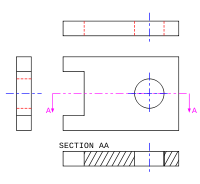
Example mechanical cartoon
Here is an example of an engineering drawing (an isometric view of the same object is shown to a higher place). The different line types are colored for clarity.
- Blackness = object line and hatching
- Red = hidden line
- Bluish = center line of slice or opening
- Magenta = phantom line or cutting plane line
Sectional views are indicated past the direction of arrows, every bit in the example correct side.
Legal instruments [edit]
An engineering drawing is a legal document (that is, a legal instrument), because it communicates all the needed information near "what is wanted" to the people who will expend resource turning the idea into a reality. It is thus a office of a contract; the purchase order and the drawing together, as well as any ancillary documents (engineering change orders [ECOs], called-out specs), constitute the contract. Thus, if the resulting production is wrong, the worker or manufacturer are protected from liability as long equally they have faithfully executed the instructions conveyed past the cartoon. If those instructions were wrong, information technology is the error of the engineer. Because manufacturing and construction are typically very expensive processes (involving big amounts of capital and payroll), the question of liability for errors has legal implications.
Relationship to model-based definition (MBD/DPD) [edit]
For centuries, engineering drawing was the sole method of transferring data from design into manufacture. In contempo decades another method has arisen, called model-based definition (MBD) or digital product definition (DPD). In MBD, the data captured by the CAD software app is fed automatically into a CAM app (calculator-aided manufacturing), which (with or without postprocessing apps) creates code in other languages such equally G-code to exist executed past a CNC car tool (computer numerical control), 3D printer, or (increasingly) a hybrid machine tool that uses both. Thus today it is ofttimes the example that the data travels from the mind of the designer into the manufactured component without having ever been codified by an applied science drawing. In MBD, the dataset, non a drawing, is the legal instrument. The term "technical data package" (TDP) is now used to refer to the complete package of information (in one medium or some other) that communicates information from pattern to product (such as 3D-model datasets, engineering drawings, engineering change orders (ECOs), spec revisions and addenda, and and then on).
It however takes CAD/CAM programmers, CNC setup workers, and CNC operators to practice manufacturing, also as other people such every bit quality balls staff (inspectors) and logistics staff (for materials handling, aircraft-and-receiving, and front office functions). These workers often use drawings in the course of their work that have been produced from the MBD dataset. When proper procedures are being followed, a articulate concatenation of precedence is always documented, such that when a person looks at a cartoon, due south/he is told by a note thereon that this drawing is non the governing instrument (because the MBD dataset is). In these cases, the cartoon is still a useful document, although legally it is classified as "for reference only", meaning that if whatever controversies or discrepancies ascend, it is the MBD dataset, not the drawing, that governs.
See likewise [edit]
- Architectural drawing
- B. Hick and Sons – Notable collection of early locomotive and steam engine drawings
- CAD standards
- Descriptive geometry
- Document management system
- Engineering cartoon symbols
- Geometric tolerance
- ISO 128 Technical drawings – General principles of presentation
- light plot
- Linear scale
- Patent drawing
- Scale rulers: builder's scale and engineer's scale
- Specification (technical standard)
- Structural drawing
References [edit]
- ^ a b M. Maitra, Gitin (2000). Practical Engineering science Cartoon. 4835/24, Ansari Road, Daryaganj, New Delhi - 110002: New Age International (P) Express, Publishers. pp. 2–v, 183. ISBN81-224-1176-2.
{{cite book}}: CS1 maint: location (link) - ^ a b Rolt 1957, pp. 29–30.
- ^ French & Vierck 1953, pp. 99–105
- ^ a b c French 1918, p. 78.
- ^ a b c French & Vierck 1953, pp. 111–114
- ^ French & Vierck 1953, pp. 97–114
- ^ French & Vierck 1953, pp. 108–111
- ^ French & Vierck 1953, p. 102.
- ^ Bertoline, Gary R. Introduction to Graphics Communications for Engineers (4th Ed.). New York, NY. 2009
- ^ United States Bureau of Naval Personnel. "Engineering science Assist 1 & C.". 1969. p. 188.
- ^ Andres Yard. Embuido. "Applied science Aid one & C". 1988. p. 7-10.
- ^ "Subcontract Planners' Technology Handbook for the Upper Mississippi Region". 1953. p. 2-5.
- ^ Farhad Ghorani. "Title Cake". 2015.
- ^ Paul Munford. "Technical cartoon standards: Grid reference frame".
- ^ Brian Griffiths. "Engineering Cartoon for Industry". 2002. p. one and p. 13.
Bibliography [edit]
- French, Thomas E. (1918), A transmission of engineering drawing for students and draftsmen (2nd ed.), New York, New York, USA: McGraw-Hill, LCCN 30018430. : Applied science Drawing (volume)
- French, Thomas E.; Vierck, Charles J. (1953), A manual of technology cartoon for students and draftsmen (eighth ed.), New York, New York, USA: McGraw-Colina, LCCN 52013455. : Engineering science Cartoon (volume)
- Rolt, Fifty.T.C. (1957), Isambard Kingdom Brunel: A Biography, Longmans Green, LCCN 57003475.
Further reading [edit]
- Basant Agrawal and C Grand Agrawal (2013). Engineering Drawing. 2d Edition, McGraw Hill Education Republic of india Pvt. Ltd., New Delhi. [one]
- Paige Davis, Karen Renee Juneau (2000). Engineering Drawing
- David A. Madsen, Karen Schertz, (2001) Engineering Drawing & Design. Delmar Thomson Learning. [two]
- Cecil Howard Jensen, Jay D. Helsel, Donald D. Voisinet Computer-aided engineering drawing using AutoCAD.
- Warren Jacob Luzadder (1959). Fundamentals of engineering drawing for technical students and professional person.
- K.A. Parker, F. Pickup (1990) Technology Drawing with Worked Examples.
- Colin H. Simmons, Dennis East. Maguire Manual of engineering drawing. Elsevier.
- Cecil Howard Jensen (2001). Interpreting Technology Drawings.
- B. Leighton Wellman (1948). Technical Descriptive Geometry. McGraw-Colina Book Company, Inc.
External links [edit]
- Examples of cubes fatigued in different projections
- Animated presentation of cartoon systems used in technical drawing (Wink animation) Archived 2011-07-06 at the Wayback Machine
- Pattern Handbook: Engineering Drawing and Sketching, past MIT OpenCourseWare
woodsideporknowle1956.blogspot.com
Source: https://en.wikipedia.org/wiki/Engineering_drawing
0 Response to "3d drawing of person in hole"
ارسال یک نظر