Tang and Song Achievements Art From Tang and Song Dynasty

Silver wine loving cup, with birds and a rabbit amidst scrolling plant forms.

Tang dynasty art (simplified Chinese: 唐朝艺术; traditional Chinese: 唐朝藝術) is Chinese art made during the Tang dynasty (618–907). The period saw cracking achievements in many forms—painting, sculpture, calligraphy, music, dance and literature. The Tang dynasty, with its capital at Chang'an (today's Eleven'an), the almost populous metropolis in the world at the fourth dimension, is regarded by historians as a high point in Chinese civilization—equal, or fifty-fifty superior, to the Han period. The Tang menstruum was considered the golden age of literature and art.
In several areas developments during the Tang set up the direction for many centuries to come up. This was especially then in pottery, with glazed plain wares in celadon green and whitish porcelaineous types brought to a loftier level, and exported on a considerable scale. In painting, the period saw the acme level of Buddhist painting, and the emergence of the mural painting tradition known equally shanshui (mountain-water) painting.
Trading along the Silk Road of various products increased cultural diversity in small Cathay cities.[1] Stimulated past contact with Republic of india and the Middle Due east, the empire saw a flowering of creativity in many fields. Buddhism, originating in what is modern twenty-four hours India around the time of Confucius, continued to flourish during the Tang menses and was adopted by the regal family, condign thoroughly sinicized and a permanent part of Chinese traditional culture. Block printing fabricated the written word available to vastly greater audiences.
Culturally, the An Lushan Rebellion of 745-763 weakened the confidence of the elite,[2] and brought an end to the lavish style of tomb figures, as well as reducing the outward-looking culture of the early on Tang, that was receptive to strange influences from farther west in Asia. The Nifty Anti-Buddhist Persecution, in fact against all strange religions, which reached its peak in 845, had a bully affect on all the arts, only especially the visual arts, greatly reducing demand for artists.
Painting [edit]

A considerable amount of literary and documentary information most Tang painting has survived, just very few works, especially of the highest quality. There is a good deal of biographical information and art criticism, mostly from later periods such as the Ming dynasty, several centuries after the Tang; the accuracy of this needs to be considered, and much of it was probably already based on seeing copies of the art, not originals. With a very few exceptions, traditional attributions of particular scroll paintings to Tang masters are now regarded with suspicion by art historians.

A walled-up cavern in the Dunhuang (Mogao Caves) circuitous was discovered by Aurel Stein, which contained a vast haul, mostly of Buddhist writings, but also some banners and paintings, making much the largest group of paintings on silk to survive. These are now in the British Museum and elsewhere. They are not of courtroom quality, but prove a diversity of styles, including those with influences from farther west. As with sculpture, other survivals showing Tang style are in Japan, though the most important, at Nara, was very largely destroyed in a fire in 1949.[three]
The rock-cutting cave complexes and regal tombs also contain many wall-paintings; the paintings in the Qianling Mausoleum are the most important group of the latter, generally now removed to a museum. Non all the royal tombs accept yet been opened. Court painting mostly survives in what are certainly or arguably copies from much after, such as Emperor Taizong Receiving the Tibetan Envoy, probably a later re-create of the 7th century original by Yan Liben, though the front end section of the famous portrait of the Emperor Xuanzong's horse Night-Shining White is probably an original by Han Gan of 740–760.[4] Yan Liben is an example of a famous painter who was also a very important official.
Nearly Tang artists outlined figures with fine blackness lines and used bright color and elaborate detail filling in the outlines. Withal, Wu Daozi used only black ink and freely painted brushstrokes to create ink paintings that were and then heady that crowds gathered to watch him work. From his time on, ink paintings were no longer thought to exist preliminary sketches or outlines to be filled in with color. Instead, they were valued as finished works of art.
The Tang dynasty saw the maturity of the landscape painting tradition known equally shanshui (mountain-water) painting, which became the well-nigh prestigious type of Chinese painting, specially when skilful by amateur scholar-official or "literati" painters in ink-wash painting. In these landscapes, usually monochromatic and sparse, the purpose was not to reproduce exactly the appearance of nature merely rather to grasp an emotion or atmosphere so every bit to grab the "rhythm" of nature.
-

-

Buddhist mural in the Bezeklik grottoes, ninth century
Pottery [edit]

Chinese ceramics saw many significant developments, including the start Chinese porcelain meeting both Western and Chinese definitions of porcelain, in Ding ware and related types. The earthenware Tang dynasty tomb figures are better known in the West today, but were only made to placed in elite tombs close to the upper-case letter in the north, between about 680 and 760. They were perhaps the last pregnant fine earthenwares to be produced in Red china. Many are lead-glazed sancai (three-colour) wares; others are unpainted or were painted over a slip; the paint has now often fallen off.
Sancai was also used for vessels for burial, and peradventure for employ; the glaze was less toxic than in the Han, only maybe even so to exist avoided for use at the dining table. The typical shape is the "offering tray", a round or circular and lobed shape with geometrically regular floral-blazon ornament in the heart.
In the south the wares from the Changsha Tongguan Kiln Site in Tongguan are significant as the get-go regular use of underglaze painting; examples accept been establish in many places in the Islamic world. However the product tailed off and underglaze painting remained a pocket-sized technique for several centuries.[5]
Yue ware was the leading high-fired, lime-glazed celadon of the flow, and was of very sophisticated design, patronized by the court. This was also the case with the northern porcelains of kilns in the provinces of Henan and Hebei, which for the first time met the Western as well every bit the Eastern definition of porcelain, being a pure white and translucent.[6] I of the start mentions of porcelain by a foreigner was in the Chain of Chronicles written by the Arab traveler and merchant Suleiman in 851 AD during the Tang dynasty who recorded that:[7] [8]
They have in China a very fine dirt with which they brand vases which are as transparent as glass; water is seen through them. The vases are made of dirt.
The Arabs were well used to drinking glass, and he was certain that the porcelain that he saw was not that.
Yaozhou ware or Northern Celadon also began nether the Tang, though like Ding ware its best period was under the adjacent Song dynasty.
-

Yue ware vase with incised ornamentation, c. 900, "light-green-glazed porcelaneous stoneware"
-

"Offering plate" with sancai glaze, 8th century.
-

"Offering plate" with sancai coat, busy with a bird and trees, 8th century.
-

"Offering plate" with sancai with vi eaves and "iii colors" glaze, eighth century.
-

Tomb figures: 3 of eight lady musicians on horseback, early 8th century
-

Ladies dancing, 7th century
-

Tomb figure of a plump Tang adult female
-

Tomb figure of a foreigner with a wineskin, c. 674–750
-

Tomb figure, 7th-8th century
-

Tomb figure of a Sogdian human being wearing a distinctive cap and face veil, possibly a camel rider or even a Zoroastrian priest engaging in a ritual at a fire temple, eighth century Advertizing
Sculpture [edit]

Most sculpture before the official rejection of Buddhism in 845 was religious, and a vast amount was destroyed during the Tang menstruum itself, with most of the residue lost in later periods. There were many bronze and wooden sculptures, whose style is all-time seen in the survivals in Japanese temples. Awe-inspiring sculpture in rock, and also terracotta, has survived at several complexes of stone-cut temples, of which the largest and nigh famous are the Longmen Grottoes and the Mogao Caves (at Dunhuang), both of which were at their peak of expansion during the Tang. The best combined "the Indian feeling for solid, swelling course and the Chinese genius for expression in terms of linear rhythm ... to produce a manner which was to get the basis of all later Buddhist sculpture in China."[9]
The tomb-figures are discussed above; though probably non treated very seriously as art past their producers, and sometimes rather sloppily made, and particularly painted, they remain vigorous and effective as sculpture, especially when animals and foreigners are depicted, the latter with an element of caricature. A rather different grade and type of tomb sculpture is seen in the reliefs of the half-dozen favourite horses at the mausoleum of Emperor Taizong (d. 649). Past tradition these were designed past the court painter Yan Liben, and the relief is then apartment and linear that it seems likely they were carved subsequently drawings or paintings.[ten]
-

-

Tang dynasty bodhisattva statue missing its head and left arm
-

A limestone statue of a mourning attendant, seventh century
-

Metalwork and decorative arts [edit]

Tang elite metalwork, surviving mostly in bronze or silverish cups and mirrors, is oft of superb quality, decorated using a variety of techniques, and often inlaid with gilded and other metals. An exceptionally fine deposit is the collection in the Tōdai-ji in Nara in Japan of the personal goods of Emperor Shōmu, given to the Buddhist shrine by his girl Empress Kōmyō after her father's death in 756. As well as metalwork, paintings and calligraphy, this includes furniture, glass, lacquer and woods pieces such as musical instruments and board games. Well-nigh is probably made in China, though some is Japanese and some from the Middle Due east.[11]
Another important deposit was discovered in 1970 at Xi'an when the Hejia Village hoard was uncovered by construction. Placed into two large ceramic pots, 64 cm high, and a silvery ane, 25 cm high, this was a big drove of over a thousand objects, altogether representing a rather puzzling collection. Several of them were gold or argent vessels and other objects of the highest quality, as well as hardstone carvings in jade and agate, and gemstones. Information technology was probably hidden in a hurry during the An Lushan defection, in which the Tang capital was taken more than once. Many of the objects are imported, by and large from along the Silk Road, especially Sogdia, and others testify Sogdian influence.[12] 2 objects from the hoard (illustrated) are included on the very select official list of Chinese cultural relics forbidden to be exhibited abroad. The hoard is at present in the Shaanxi History Museum.
-

Gilded hexagonal silver plate with a Fei Lian fauna pattern
-

-

Mirror with floral medallion, constitute sprays, birds, and insects, seventh century
Architecture [edit]

There had been an enormous amount of building of Buddhist temples and monasteries, just in 845 these were all confiscated past the government, and the cracking majority destroyed. The normal construction material for buildings other than towers, pagodas, and war machine works in the Tang was yet wood, which does not survive very long if not maintained.[13] The rock-cut architecture of the famous surviving sites of course survives neglect far meliorate, but the Chinese generally left the external facades of cave-temples unornamented, dissimilar the Indian equivalents at sites similar the Ajanta Caves.
Two big Tang pagodas survive in the capital letter, now 11'an, which otherwise has few remains dating dorsum to the Tang. The oldest is the Giant Wild Goose Pagoda, rebuilt in 704 in brick, and reduced in height after damage in the 1556 Shaanxi convulsion. The Small-scale Wild Goose Pagoda was also rebuilt in 704, simply just lost a few metres in the earthquake. Some Tang pagodas tried to reconcile the form with the Indian shikara temple tower, or even had a stupa as role of the superstructure; the Tahōtō at the Ishiyama-dera temple in Japan is a surviving later example, with a roof on top of the stupa.[14]
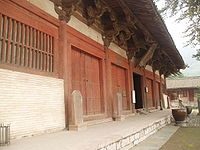
The primary hall of the relatively modest rural Nanchan Temple has a main construction of wood. Much of information technology appears to have survived from the original structure in 782, and it is recognised as the oldest wooden building in Red china. The third oldest is the main hall of the nearby Foguang Temple of 857.[15]
Both are studied for their dougong bracketing systems, joining the roof to the walls. These complicated arrangements persisted until the stop of traditional Chinese architecture, merely are oftentimes considered to have reached a elevation of elegance and harmony in the Vocal and Yuan dynasties, before condign over-elaborate and fussy. The Tang examples prove an increase in complication before the groovy periods, and the ancestry of the uplift at the edges of roof lines that was to grow stronger in later periods. Nihon has preserved rather more temple halls congenital in very similar styles (or in many cases has carefully rebuilt them as exact replicas over the centuries).[16]
-
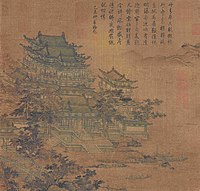
Luoyang Pavilion by Li Zhaodao (fl. early on 8th c.)
-

-

-

The Ix Superlative Pagoda of Shandong, completed by 756 and crowned with an unusual prepare of miniature pagodas; it is also unique for its octagonal, rather than foursquare, base programme.
-
Music [edit]
The first major well-documented flowering of Chinese music was for the qin during the Tang dynasty, though the qin is known to accept been played since before the Han dynasty.
Late 20th century excavations of an intact tomb of the period revealed not merely a number of instruments (including a spectacular concert bong set) but also inscribed tablets with playing instructions and musical scores for ensemble concerts, which are now heard again as played on reproduction instruments at the Hubei Provincial Museum.
Opera [edit]
Chinese opera is by and large dated dorsum to the Tang dynasty with Emperor Xuanzong (712–755), who founded the Pear Garden, the first known opera troupe in People's republic of china. The troupe by and large performed for the emperors' personal pleasance.
Poetry [edit]
The poetry of the Tang dynasty is perhaps the most highly regarded poetic era in Chinese poetry. The shi, the classical grade of poetry which had adult in the late Han dynasty, reached its zenith. The album 3 Hundred Tang Poems, compiled much afterward, remains famous in China.
During the Tang dynasty, poetry became popular, and writing poetry was considered a sign of learning. Ane of Red china'due south greatest poets was Li Po, who wrote about ordinary people and about nature, which was a powerful force in Chinese art. 1 of Li Po'southward short poems, "Waterfall at Lu-Shan", shows how Li Po felt nigh nature.
Tang dynasty artists [edit]

- Bai Juyi (772–846), poet
- Zhou Fang (730–800), painter, also known every bit Zhou Jing Xuan and Zhong Lang
- Cui Hao (?–754), poet
- Han Gan (718–780), painter
- Zhang Xuan (713–755), painter
- Du Fu (712–770), poet
- Li Bai (701–762), poet
- Meng Haoran (689 or 691–740), poet
- Wang Wei (699–759), poet, musician, painter
- Wu Tao-Tzu (680–740), famous for the myth of entering an fine art work
- Zhang Jiuling (678–740), poet
See also [edit]
- Chinese fine art
- Qianling Mausoleum
Notes [edit]
- ^ Birmingham Museum of Fine art (2010). Birmingham Museum of Art : guide to the collection. [Birmingham, Ala]: Birmingham Museum of Art. p. 24. ISBN978-one-904832-77-5.
- ^ Sullivan, 145
- ^ Sullivan, 132-133
- ^ Sullivan, 134-135
- ^ Vainker, 82–84
- ^ Vainker, 64–72
- ^ Temple, Robert Grand.G. (2007). The Genius of Communist china: 3,000 Years of Science, Discovery, and Invention (3rd edition). London: André Deutsch, pp. 103–six. ISBN 978-0-233-00202-6
- ^ Bushell, South. W. (1906). Chinese Art. Victoria and Albert Museum Fine art Handbook, His Majesty's Stationery Office, London.
- ^ Sullivan, 126-127, 127 quoted
- ^ Sullivan, 126
- ^ Sullivan, 139-140
- ^ Hansen, 152-157; Sullivan, 139
- ^ Sullivan, 123-124
- ^ Sullivan, 125-126
- ^ Sullivan, 124
- ^ Sullivan, 124-125
References [edit]
- Hansen, Valerie, The Silk Road: A New History, 2015, Oxford Academy Press, ISBN 0190218428, 9780190218423, google books
- Sullivan, Michael, The Arts of China, 1973, Sphere Books, ISBN 0351183345 (revised edn of A Short History of Chinese Art, 1967)
- Vainker, Southward.J., Chinese Pottery and Porcelain, 1991, British Museum Press, 9780714114705
Farther reading [edit]
- Watt, James C.Y.; et al. (2004). Prc: dawn of a golden age, 200-750 AD . New York: The Metropolitan Museum of Art. ISBN1588391264.
woodsideporknowle1956.blogspot.com
Source: https://en.wikipedia.org/wiki/Tang_dynasty_art
0 Response to "Tang and Song Achievements Art From Tang and Song Dynasty"
ارسال یک نظر